Friday, November 22, 2013

Ineffective Assistance of Counsel in Capital Cases


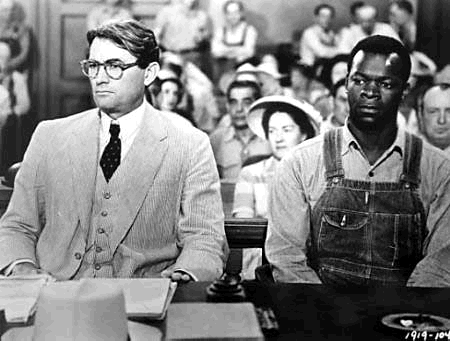
To Kill a Mockingbird: Atticus Finch and Tom Robinson
The Sixth Amendment of the United States Constitution grants criminal defendants the right to counsel in federal cases.  In 1963 the Supreme Court extended this right to state felony prosecutions in the landmark case Gideon v. Wainwright.  Twenty-one years after Gideon, the Supreme Court in Strickland v. Washington held that the right to counsel really means the right to effective assistance of counsel.  Generally speaking, ineffective assistance of counsel (IAC) can be defined as errors by counsel so severe in nature that the criminal defendant was denied a fair trial.  Strickland provides a specific test.  Under Strickland, a defendant must establish: (1) their trial lawyer’s performance fell short of an “objective standard of reasonableness” and (2) “a reasonable probability that, but for counsel’s unprofessional errors, the result of the proceeding would have been different.”  


The right to effective assistance of counsel obviously is important for criminal practitioners and for law students who wish to enter the field.  This post will provide three instances in which IAC claims are commonly brought, as well as analysis and advice on what does and does not constitute IAC in those situations.  The three instances are: inexperience of counsel; counsel’s failure to search for mitigating evidence in penalty phases of murder trials; and counsel’s failure to object to the requirement that the defendant wear restraints in front of the jury.

In U.S. v. Bergman, a recent Tenth Circuit case, Gwen Bergman pled guilty to violating federal law after she paid $30,000 to a undercover law enforcement agent posing as a hit man to murder her ex-husband.  Bergman, though, later discovered her counsel had never been a licensed attorney.  The Tenth Circuit held that it was per seIAC when a “man claiming to have been successfully admitted to the bar, but who never attended law school or even graduated from college” and was a convicted felon represented a criminal defendant.  However, nervous, fledgling lawyers should not be worried: The Seventh Circuit (albeit before Strickland) has held that the “mere inexperience of trial counsel” does not by itself establish IAC.[1]  Referencing Shakespeare, the court noted “Portia without experience was a remarkably successful representative of Antonio” to make the point that the lawyer’s actions, not experience, determine the effectiveness of their counsel.[2]

While this is a somewhat lighthearted example, it is important to note that IAC claims commonly arise after a defendant has been convicted of and sentenced for murder.  Often, the issue is whether counsel performed a reasonable investigation into mitigating evidence for a defendant’s penalty phase of his or her murder trial.[3]  For example, in Wiggins v. Smith, the Supreme Court held that defense counsel’s decision to limit the investigation looking for mitigating evidence to the presentence investigation reports and social services records fell short of prevailing standards in capital cases and thus constituted IAC.  

In contrast,  counsel’s decision in Strickland to not seek out character witnesses or request a psychiatric evaluation was not IAC.  One of the lessons from these cases is that a Strickland analysis is very fact-specific: in Strickland the murders were especially brutal, less mitigating evidence was available, and the defendant acted against counsel’s advice by confessing to two murders and waiving his right to a jury trial, making his situation “hopeless”; in Wiggins, on the other hand, “[t]he mitigating evidence counsel failed to discover and present [was] powerful” as the defendant had an “excruciating life history” which counsel failed to explore and introduce.

IAC claims also can arise when a defendant is convicted of murder after a trial in which he or she was wearing restraints in front of the jury.  In a recent Alabama federal district case, Geoffrey Todd West, found guilty at trial of capital murder during the course of a robbery, brought several IAC claims against his attorneys, including their failure to object to the requirement he wear a stun belt during trial.[4]  Despite acknowledging that appearing before a jury in restraints can be highly prejudicial to a defendant, the court found no IAC because the attorney’s failure to object was actually a conscious, strategic decision and thus fell within the language of Strickland that encouraged lower courts to be highly deferential to strategies of counsel.[5]

In conclusion, it is important to know about IAC claims as they can lead to sanctions and maybe even civil suits for malpractice, as well as harm to the lawyer’s reputation and career.  More important than this, though, is the welfare of the client, especially in capital cases.  Accordingly, this post is not meant to show current and future practitioners what the minimum standard of effective counsel is, but instead to inform them what is expected and required of criminal attorneys to help ensure defendants receive competent and thorough representation. 

The most important takeaway from Strickland, then, is that “strategic choices made after thorough investigation of law and facts relevant to plausible options are virtually unchallengeable.”  Although this goes beyond the barebones requirements of Strickland, strategic decisions based on a thorough investigation will lead to effective representation while protecting attorneys from IAC claims.


James K. Howard
Senior Editor, Criminal Law Practitioner 


Image by Moni3 [Public domain], via Wikimedia Commons.

[1] U.S. ex rel. Williams v. Twomey, 510 F.2d 634, 638-39 (7th Cir. 1975).
[2] Id. at 639.
[3] See, e.g., Wiggins v. Smith, 539 U.S. 510 (2003); Strickland v. Washington, 466 U.S. 668 (1984).
[4] West v. Allen, 868 F.Supp. 1224, 1240, 1255 (N.D. Ala. 2011).
[5] See id. at 1253 (citing Strickland, 466 U.S. at 689).

Tuesday, November 19, 2013

Self Defense or Murder?: Is the Shooting of Renisha McBride the Next Big Story?


As the country begins to move past the media frenzy that followed the killing (or murder, depending on where you stand) of Trayvon Martin, a new incident has occurred that seems prime to dominate headlines.  Around 1:00 am on November 2, 2013, Renisha McBride drove her vehicle into a parked car in suburban Detroit.  Tests would show that McBride had a blood alcohol content of 0.218%, well above the legal limit in Michigan.  A few hours later, a “bloodied and disoriented” McBride approached the porch of Dearborn Heights resident Theodore Wafer.  Sources report that McBride began to knock on Wafer’s door, prompting Wafer to come downstairs with his shotgun.  Wafer, standing in his home, discharged his weapon through a closed screen door, striking and killing the twenty-four year old McBride.  Wafer then called 911 to report the shooting.  Wafer told investigators that he brought down the shotgun because he believed McBride was attempting to break into his house (though there were no signs of forced entry).  He also claims that the weapon accidentally discharged while he was investigating the situation.  McBride died shortly after and Wafer has been charged with second degree murder.


There is no doubt that the story will garner attention because of its societal implications.  McBride was young, black, unarmed, and presumed to be committing a crime by a fifty-four year old white man.  Further, while there are not many witnesses, it is far more likely that McBride was seeking medical aid than trying to rob a house.  The case has already drawn comparisons to the Martin case, with reporters and bloggers putting extra emphasis on the issues of racial profiling and gun control.

While the lack of a post-racial society and the potential cry for stricter gun laws are more likely to pull readers in, the criminal law elements of the story are also fascinating.  Like Florida, Michigan has a “stand your ground law,” a statute that permits individuals to use lethal force rather than flee when they are threatened.  Section 780.972 of the Michigan Code states:

(1) An individual who has not or is not engaged in the commission of a crime at the time he or she uses deadly force may use deadly force against another individual anywhere he or she has the legal right to be with no duty to retreat if either of the following applies:

(a) The individual honestly and reasonably believes that the use of deadly force is necessary to prevent the imminent death of or imminent great bodily harm to himself or herself or to another individual.

(b) The individual honestly and reasonably believes that the use of deadly force is necessary to prevent the imminent sexual assault of himself or herself or of another individual.

(2) An individual who has not or is not engaged in the commission of a crime at the time he or she uses force other than deadly force may use force other than deadly force against another individual anywhere he or she has the legal right to be with no duty to retreat if he or she honestly and reasonably believes that the use of that force is necessary to defend himself or herself or another individual from the imminent unlawful use of force by another individual.[1]

More importantly, section 768.21C of the Michigan Code states that an individual does not have a duty to retreat before using deadly force if the individual is in his or her own dwelling or within the curtilage of that dwelling.[2] Like most self-defense statutes, the individual must have a reasonable belief “that he is in imminent danger of either losing his life or suffering great bodily harm, and that the use of deadly force is necessary to prevent that harm.”  The reasonable belief standard is that of an objective reasonable person.

The case will likely come down to two questions: (1) would an objective reasonable person in Theodore Wafer’s position believe that he was in imminent danger of losing his life or suffering great bodily harm to the extent that the use of deadly force would be necessary to prevent that harm, and (2) did Wafer accidentally discharge his weapon or did he purposely shoot at Renisha McBride?  While the legal scholar in all of us would love to ignore the societal and policy implications of the case, they are intrinsically linked to these questions.  To the first question, race clearly plays a role.  An objective, reasonable, person would not presume an individual is breaking into their house simply because of the color of their skin.  Other factors are also at play (though it was four am and McBride was covered in blood, albeit her own, there were no signs of attempted forced entry).  If he testifies, Wafer will have to answer questions regarding why he thought McBride was trying to break in.  If that answer insists it was because she was black, then it is likely a jury would find that an objective, reasonable person would not have believed they were in danger.

The second question plays more to the role of guns in society.  Arguably the most vocal argument regarding guns is their use for protecting individuals in their homes.  A handgun or shotgun in the dwelling seems to be the backbone of the second amendment, for it insists upon one’s right to protect themselves in their most sacred place (not to mention the notion of keeping the government out of one’s home).  Yet the Renisha McBride killing brings light to the issue of responsible gun ownership, even within the home.  How do we as a society justify the shooting of an injured twenty-four year old woman?  Defending one’s castle?  The facts of this case will no doubt bring light to the age old debate of whether guns make society safer or more dangerous.  This will also broaden the debate on self-defense laws in the United States.  On both sides of the argument, supporters and detractors of “stand your ground” or “defend your castle” laws will be keeping an eye on this case, as will Congress who has reviewed stand your ground policies in the wake of the Trayvon Martin case.

Renisha McBride’s death is a tragedy.  As Huffington Post and Fox News start preparing their editorials, the criminal law scholars will certainly have a lot to consider.  The case presents interesting legal issues that are directly tied to national policy concerns.  Like the Trayvon Martin case, the Nation will certainly have questions: How do we become a post-racial society?  Are we too quick to label something as racial profiling?  How can we protect ourselves from guns?  How do we protect ourselves from tightening gun laws?  Hopefully a courtroom in Michigan will provide criminal law practitioners some answers to these complicated ideas.


Calen Weiss
Articles Editor, Criminal Law Practitioner


Image from Facebook.

[1] Mich. Comp. Laws §780.972 (2013).
[2] Mich. Comp. Laws §768.21C(a) (2013).

Friday, November 15, 2013

From Criminal to Star Witness – The Paradox of Cooperating Witnesses in White Collar Cases


Frank DiPascali Mug Shot

Despite Bernie Madoff’s claim that he alone perpetrated the roughly seventeen billion dollar ponzi scheme, the government has pursued charges against a number of other individuals.  After a five-year investigation, at the heart of the prosecution’s case is a cooperating witness.  In August 2009, Frank DiPascali, Madoff's former Chief Financial Officer, pled guilty to ten counts of fraud, conspiracy, and other charges, and admitted to the court, “I helped Bernie Madoff and other people carry out a fraud."  In the ongoing case that began in October against five former employees of Madoff’s financial firm, DiPascali is expected to testify and provide key evidence in hope of reducing the length of the prison sentence he will likely receive. 


Because conspiracies are secret by their nature, prosecutors often rely on cooperating witnesses to prove these cases.   A cooperating witness is a person who participated in the crime and is willing to assist the investigation and/or testify about the roles played by the co-conspirators.  Usually a witness cooperates in hope of mitigating the severity of the punishment the witness faces for his own involvement in the criminal activity.  These cooperation agreements are typically included within a plea agreement and require the witness to admit his criminal conduct, plead guilty, and agree to assist the government in its investigation and prosecution of other individuals.  If the government deems the assistance “substantial,” it will file what is known as a §5K1.1 motion and request that the court depart downward from the recommended guidelines sentencing range for the cooperating witness.  In turn, this reduces the witness’s likely punishment.

The government’s use of cooperating witnesses such as DiPascali has raised concerns in recent years about jurors’ overreliance on cooperating witness testimony and the justice system’s inability to balance out that effect.  Neuschatz et al. (2008) conducted one of the first psychological studies regarding the effect of informant and cooperating witness testimony on juror decision making.  In that study, participants acting as jurors read trial transcripts that included testimony from an accomplice who allegedly acquired information through involvement in the alleged crime.[1]  The experimenters manipulated whether the jurors also learned that the cooperating witness received sentencing incentives in exchange for his/her testimony.  The participants were then asked questions regarding whether they would convict the defendant, and to what they attributed the witness’s motivation for coming forward.  The results indicated that information about the cooperating witness’ incentive (e.g., leniency or reward) did not affect participants’ verdict decisions.  With regard to the witness’s motivation for testifying, the experimenters noted that the participants overwhelmingly committed what is known as the fundamental attribution error – they ignored the contextual and situation factors (i.e., receiving leniency) and instead attributed the witness’s motivation to dispositional factors (i.e., the witness wanted to “do the right thing”).  Essentially, the jurors accepted the witness’s testimony without considering the witness’s motive or inducement to fabricate.

Beyond the limited social psychology research on the topic, many other concerns about cooperating witness testimony have emerged.  For instance, some surmise that, because cooperating witnesses in white collar criminal prosecutions are less likely to have extensive criminal backgrounds and appear sophisticated and presentable, jurors may be more likely to believe them than the typical jailhouse “snitch.”[2]  Many have also noted the “cooperation paradox” as a sign of the unfairness of the use of cooperating witnesses: those who are the most culpable, have the most information about the criminal activity, and face the greatest penalties are the ones most likely to be offered cooperation deals to testify against low-level individuals.[3]

Defendants have also been somewhat restricted by the courts in their ability to attack cooperating witness testimony.  In Daubert v. Merrill Dow Pharmaceuticals Inc., the Supreme Court noted at least three safeguards the accused has to discredit unreliable testimony: (i) cross examination, (ii) presentation of contrary evidence, such as that provided by expert witnesses, and (iii) judicial instructions to the jury.  However, the Fifth Circuit recently affirmed the district court’s refusal to allow defense counsel to cross examine a cooperating witness regarding the witness’s actual exposure under the Federal Sentencing Guidelines.  The Fifth Circuit held that these limitations did not violate the Confrontation Clause.  Additionally, the Fourth Circuit held that understanding the ramifications a cooperating witness’s plea agreement, and thus the witness's motivations, did not require expert testimony.  Rather, this was a matter of “common sense” and one that the jury could decide for itself without the aid of expert testimony.

This is not to say that the government’s use of cooperating witness testimony is completely without safeguards.  Prosecutors have a constitutional duty to disclose any incentives offered to cooperating witnesses in addition to strict ethical guidelines to disclose information regarding cooperation agreements.  Courts have also adopted cautionary jury instructions regarding how much weight the jury should give to cooperators’ testimony.  Ultimately, perhaps the best safeguard is a skillful cross examination.  Richard Bistrong, who in 2007 cooperated with the FBI and Department of Justice and testified against others in a criminal Foreign Corrupt Practices Act case, endured three weeks of cross examination by six separate defense attorneys.  Afterward, he explained that “[i]t was difficult and there was nothing that could have prepared me for what I endured on the stand over that period of time.”


Kyle O'Grady
Senior Editor, Criminal Law Practitioner


Image by United States Marshals Service [Public domain], via Wikimedia Commons.


[1]Control groups in the study were not exposed to testimony from the cooperating witness.
[2]Ellen S. Podgor, White-Collar Cooperators: The Government in Employer-Employee Relationships, 23 Cardozo L. Rev. 795, 802-803 (2002).
[3]See, e.g., id. at 799; Stephen J. Schulhofer, Rethinking Mandatory Minimums, 28 Wake Forest L. Rev. 199, 212 (1993).