Showing posts with label Sixth Amendment. Show all posts

Monday, July 6, 2015

Asset Forfeiture and the Sixth Amendment Right to Counsel of Choice: Should Crime Pay?

On June 8, 2015, the United States Supreme Court agreed to hear the issue of whether a criminal defendant’s rights to due process and counsel of choice under the Fifth and Sixth Amendments are violated if the court orders a pretrial freeze of the defendant’s assets; assets which may be necessary for the defendant to hire private.

In Luis v. United States, the defendant, Sila Luis, was charged with Medicare fraud in the Southern District of Florida.  Luis was indicted in 2012 on fraud charges involving around $45 million in illegal Medicare payments.  The FBI said Luis, president of a healthcare provider, paid kickbacks and bribes to Medicare patient recruiters and submitted false claims for work done on behalf of its beneficiaries.  Once indicted, federal prosecutors froze Luis’s assets the same day, but Luis argued that the frozen assets were in no way connected to the alleged crimes and that prosecutors violated her Sixth Amendment rights since she needed the money to hire an attorney to mount a defense.  In a motion responding to the prosecutor’s temporary restraining order, Luis argued, “the Fifth and Sixth Amendments, individually and in combination, require that the court exempt from restraint and forfeiture those assets needed for (and ultimately expended on) [] legal defense to the charges pending before [the court].”  Further, she argued that by freezing her untainted assets before trial, the government not only “cripple[d] [her] ability to retain [private] counsel,”  but it also deprived her of money she would have invested “for the best and most industrious investigators, experts, paralegals, and law clerks, to at least attempt to match the litigation support available to the United States Attorney’s Office.”

However, the lower court ruled against Luis after federal prosecutors argued that freezing the assets was necessary because she had already spent the tainted money on travel and luxury goods, and freezing the remaining funds were necessary to recover the full value of alleged fraud if convicted.  The court, in conclusion, stated that there is “no Sixth Amendment right to use untainted, substitute assets to hire counsel.”  The court also quoted an analogy from the Fourth Circuit’s decision in In re Forfeiture Hearing As to Caplin & Drysdale, Chartered, which illustrated a bank robbery involving $100,000, after which, the defendant is arrested in possession of the $100,000.  The defendant, without proof, argues his innocence and claims the money to be a gift from a friend.  The Fourth Circuit provided that no reasonable person would “contend that the $100,000 must be made available to pay for the defendant’s lawyer, and not be kept available for return to the bank in the event the defendant is found guilty.”  In reliance on the analogy, the Fourth Circuit held that prosecutors may take steps to freeze a defendant’s assets.

The Luis case differs from the case that was before the Fourth Circuit.  In Luis, the defendant’s frozen assets were not traceable to the fraud scheme.  The lower court again relied on the Fourth Circuit’s analogy, adding that the bank robber spent the $100,000 shorty after stealing it, but it just so happens he has an extra $100,000 obtained legitimately sitting in a bank account.  The court provided that Congress authorized restraint of those substitute assets in 18 U.S.C. § 1345 and therefore, the bank has the right to have those substitute, untainted assets kept available for return.
The Eleventh Circuit also rejected Luis’s arguments without any further explanation.  The Supreme Court granted certiorari to decide whether Luis’s Sixth Amendment right to hire counsel of choice should outweigh prosecutorial efforts to recover the full value of alleged fraud against the government.

The Fifth Amendment provides that “No person shall be … deprived of … property, without due process of law.”  Further, the Sixth Amendment provides that criminal defendants “enjoy the right … to have the assistance of Counsel for his defense.”  The Supreme Court has subsequently found in Powell v. Alabama that “a defendant should be afforded a fair opportunity to secure counsel of his own choice.”  This right to counsel of choice has been upheld even recently in the 2006 United States v. Gonzalez-Lopez decision, when the Supreme Court found that a defendant’s right to counsel is violated “whenever the defendant’s choice is wrongfully denied,” and such an error “pervades the entire trial.”

However, last term, the Supreme Court in Kaley v. United States reaffirmed the government’s ability to freeze property and/or money if there is a chance it could be tied to illegal activity.  The Court first approved of the government’s ability to freeze a defendant’s assets in the 1989 United States v. Monsanto decision, where the Court approved the constitutionality of such an order as long as it is “based on a finding of probable cause to believe that the property will ultimately be proved forfeitable.”  The Kaley Court held that standard to apply even when the defendant seeks to use the disputed assets to pay for counsel.  Since Monsanto, lower courts have provided hearings to defendants seeking to remove an asset restraint to pay for counsel.  In these hearings, defendants have been allowed to litigate the issue of whether the assets in question are connected to the crime; however, the Kaley Court “[did] not opine on” whether pretrial restraint of untainted assets could pose constitutional problems.  Lower courts since then have differed.  For example, the Fourth Circuit has held that defendants are still guaranteed the right to counsel of choice and are allowed to use untainted assets to hire counsel, but the Court of Appeals in Luis found that Monsanto, Kaley, and Caplin & Drysdale “foreclose[d]” constitutional challenges to pretrial restraint of untainted assets needed to hire counsel of choice.

The Luis decision will be worth following because the government has increasingly used asset forfeiture as a “potent weapon” to ensure “crime doesn’t pay,” as put by Warren Richey of The Christian Science Monitor.  Many fraud cases are a result of government claims on property or stolen proceeds that are directly traceable to criminal activity; however, prosecutors have sought to freeze and preserve assets and/or proceeds that may or may not be linked to criminal activity as a form of insurance that the government will be able to collect if the defendant is convicted.  The problem with this strategy is that pretrial freezing of the defendant’s money may leave the defendant short of funds—funds necessary to hire a lawyer.

It is difficult to predict how the Supreme Court will decide in this case.  The case raises issues of the defendant’s presumption of innocence, right to counsel of choice, fairness, and property rights, all of which are rooted in the Constitution.  Chief Justice Roberts touched on the issue last year in a dissenting opinion, in which he said, “[f]ew things could do more to undermine the criminal justice system’s integrity than to allow the government to initiate a prosecution and then, at its option, disarm its presumptively innocent opponent by depriving him of his counsel of choice … [such a move would be] fundamentally at odds with our constitutional tradition and basic notions of fair play.”  

Although the Luis decision will most likely affects federal practitioners, state-level practitioners should follow this case.  Some states have various statutes providing for the forfeiture of property and/or money that was either used in criminal activity, or traceable to criminal activity.  For example, Wisconsin’s statute does not explicitly provide for or prohibit pretrial seizures of assets and there have been no cases to address the issue.  Practitioners in similarly situated states should be wary of this decision because any limitations the Supreme Court places under the Fifth and Sixth Amendments would apply to the states.

By Mahira Khan
CLP Staffer

Tuesday, April 21, 2015

Skype and the Right to Confrontation

On February 23, 2015, the petition for certiorari was denied in the case of New Mexico v. Schwartz.  What the Court failed to realize by denying this petition, is that defendants all over the nation will not get the full protection the United States Constitution requires.  As technological advances increase, our use of technology in the courtroom increases as well.  From computer monitors to email to video testimony, technology has a significant impact on the way cases are handled in the courtroom.  The ease of technology, as well as its accessibility, makes it an ever-growing issue when applied the Constitution – issues the Framers never could have imagined.[1]  In New Mexico v. Schwartz, the defendant argues that by allowing four witnesses to testify via Skype, his 6th Amendment confrontation clause rights were violated.

In this case, Martha McEachin moved from Los Angeles to Albuquerque in March 2008. She had only been living with the defendant for a month and a half when she went missing.  In May 2008, a decomposed body was found wrapped in an air mattress with sheets in an alley about 500 feet from the Defendant’s apartment.  A two-year investigation ensued and the defendant was charged with McEachin’s murder.

At the trial, four of the State’s witnesses testified using Skype.  The defendant argues that this use of video testimony violated his 6th Amendment rights.  The Confrontation Clause states that in a criminal prosecution the defendant has the right to be confronted with the witnesses against him.  The defendant argues that video testimony via Skype does not satisfy this right.  The lower court explains that the right the Confrontation Clause gives is a guaranteed face-to-face meeting with the witnesses who are appearing before the jury.  There may be exceptions to this right; however, they must be narrowly tailored to include situations that are necessary to further an important public policy.  Without a particularized showing of necessity, the right of confrontation stands.  The court goes on to explain that mere inconvenience for a witness is not sufficient grounds to violate this face-to-face right.  The court believes that the state did not show necessity for the use of video testimony, and therefore reversed the defendant’s conviction.

The outcome of this case, however, was not ideal.  If this case had made it to the Supreme Court, the question of how to determine when video testimony via Skype is appropriate would have been determined.  Practitioners and judges are now left with an open-ended question of when this type of testimony does or does not violate the Confrontation Clause.  While an argument can be made for either side, concrete criteria to protect defendants should be implemented.  With the fast rate of growing technological advances, this is not the last time the Supreme Court will be presented with this particular issue.  Right now the best a judge can do is balance the interest of the State with the rights of the defendant.  It seems this is a losing battle either way.

Kelsey Edenzon
Staffer, Criminal Law Practitioner


[1] Jamie Walker and Laura Carlsen, “Can I Testify via Skype?” Using Videoconferencing Technology to Enhance Remote Witness Testimony, NWSidebar (June 11, 2014).

Tuesday, March 3, 2015

The Plight of the Spanish-Speaking Public Defender


The role of a public defender has always played an important role in the criminal law system.  Guaranteed by the Sixth Amendment, every individual has a right to the assistance of counsel for his defense against any criminal charges brought against him.  However, as the Hispanic community in the United States grows, a unique issue in the criminal justice world has surfaced.

Tuesday, August 26, 2014

Judicial Economy Overstepping? Maryland's Lack of Recognition of Antagonistic Defenses

File:L'inégalité.JPGIt is embedded in our judicial system within the Fifth and Sixth Amendments of the United States Constitution that a person in a criminal proceeding is entitled to have a fair trial with all of his or her due process protections.  Stemming from these constitutional provisions, Maryland recognizes in Sessoms v. State the right to “ensure that an accused gets a fair trial free from undue prejudice.”  Although Sessoms is speaking directly to other crimes’ evidence, that same fairness is applied throughout the criminal justice system.

Friday, November 22, 2013

Ineffective Assistance of Counsel in Capital Cases


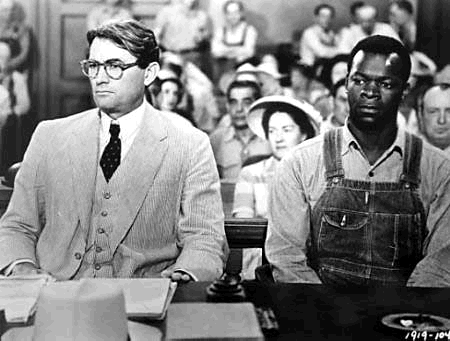
To Kill a Mockingbird: Atticus Finch and Tom Robinson
The Sixth Amendment of the United States Constitution grants criminal defendants the right to counsel in federal cases.  In 1963 the Supreme Court extended this right to state felony prosecutions in the landmark case Gideon v. Wainwright.  Twenty-one years after Gideon, the Supreme Court in Strickland v. Washington held that the right to counsel really means the right to effective assistance of counsel.  Generally speaking, ineffective assistance of counsel (IAC) can be defined as errors by counsel so severe in nature that the criminal defendant was denied a fair trial.  Strickland provides a specific test.  Under Strickland, a defendant must establish: (1) their trial lawyer’s performance fell short of an “objective standard of reasonableness” and (2) “a reasonable probability that, but for counsel’s unprofessional errors, the result of the proceeding would have been different.”  


The right to effective assistance of counsel obviously is important for criminal practitioners and for law students who wish to enter the field.  This post will provide three instances in which IAC claims are commonly brought, as well as analysis and advice on what does and does not constitute IAC in those situations.  The three instances are: inexperience of counsel; counsel’s failure to search for mitigating evidence in penalty phases of murder trials; and counsel’s failure to object to the requirement that the defendant wear restraints in front of the jury.

In U.S. v. Bergman, a recent Tenth Circuit case, Gwen Bergman pled guilty to violating federal law after she paid $30,000 to a undercover law enforcement agent posing as a hit man to murder her ex-husband.  Bergman, though, later discovered her counsel had never been a licensed attorney.  The Tenth Circuit held that it was per seIAC when a “man claiming to have been successfully admitted to the bar, but who never attended law school or even graduated from college” and was a convicted felon represented a criminal defendant.  However, nervous, fledgling lawyers should not be worried: The Seventh Circuit (albeit before Strickland) has held that the “mere inexperience of trial counsel” does not by itself establish IAC.[1]  Referencing Shakespeare, the court noted “Portia without experience was a remarkably successful representative of Antonio” to make the point that the lawyer’s actions, not experience, determine the effectiveness of their counsel.[2]

While this is a somewhat lighthearted example, it is important to note that IAC claims commonly arise after a defendant has been convicted of and sentenced for murder.  Often, the issue is whether counsel performed a reasonable investigation into mitigating evidence for a defendant’s penalty phase of his or her murder trial.[3]  For example, in Wiggins v. Smith, the Supreme Court held that defense counsel’s decision to limit the investigation looking for mitigating evidence to the presentence investigation reports and social services records fell short of prevailing standards in capital cases and thus constituted IAC.  

In contrast,  counsel’s decision in Strickland to not seek out character witnesses or request a psychiatric evaluation was not IAC.  One of the lessons from these cases is that a Strickland analysis is very fact-specific: in Strickland the murders were especially brutal, less mitigating evidence was available, and the defendant acted against counsel’s advice by confessing to two murders and waiving his right to a jury trial, making his situation “hopeless”; in Wiggins, on the other hand, “[t]he mitigating evidence counsel failed to discover and present [was] powerful” as the defendant had an “excruciating life history” which counsel failed to explore and introduce.

IAC claims also can arise when a defendant is convicted of murder after a trial in which he or she was wearing restraints in front of the jury.  In a recent Alabama federal district case, Geoffrey Todd West, found guilty at trial of capital murder during the course of a robbery, brought several IAC claims against his attorneys, including their failure to object to the requirement he wear a stun belt during trial.[4]  Despite acknowledging that appearing before a jury in restraints can be highly prejudicial to a defendant, the court found no IAC because the attorney’s failure to object was actually a conscious, strategic decision and thus fell within the language of Strickland that encouraged lower courts to be highly deferential to strategies of counsel.[5]

In conclusion, it is important to know about IAC claims as they can lead to sanctions and maybe even civil suits for malpractice, as well as harm to the lawyer’s reputation and career.  More important than this, though, is the welfare of the client, especially in capital cases.  Accordingly, this post is not meant to show current and future practitioners what the minimum standard of effective counsel is, but instead to inform them what is expected and required of criminal attorneys to help ensure defendants receive competent and thorough representation. 

The most important takeaway from Strickland, then, is that “strategic choices made after thorough investigation of law and facts relevant to plausible options are virtually unchallengeable.”  Although this goes beyond the barebones requirements of Strickland, strategic decisions based on a thorough investigation will lead to effective representation while protecting attorneys from IAC claims.


James K. Howard
Senior Editor, Criminal Law Practitioner 


Image by Moni3 [Public domain], via Wikimedia Commons.

[1] U.S. ex rel. Williams v. Twomey, 510 F.2d 634, 638-39 (7th Cir. 1975).
[2] Id. at 639.
[3] See, e.g., Wiggins v. Smith, 539 U.S. 510 (2003); Strickland v. Washington, 466 U.S. 668 (1984).
[4] West v. Allen, 868 F.Supp. 1224, 1240, 1255 (N.D. Ala. 2011).
[5] See id. at 1253 (citing Strickland, 466 U.S. at 689).