Showing posts with label Andrew Guthrie Ferguson. Show all posts

Friday, September 20, 2013

Juries: The Community Conscience in America


There it is.  “Breaking News: Verdict reached!” scrolls along the bottom portion of your television screen or appears as a notification on your newest smart phone.  We have all seen it.  We have all waited in nervous anticipation for it.  We flick to the nearest news channel, turn up the volume, and crowd around the screen as the criminal trial enters the final stretch.  Those final words are then composedly uttered, “We the jury find the defendant…”


Some rejoice, some scream expletives at the screen, and others reflect.  Some doubt the American legal system and yet others feel comforted by the protection it offered for their interests.  Either way, it served its intended truth-finding function – at least for the moment – and offered a just outcome.  Andrew Guthrie Ferguson, professor of law and former public defender, calls it “judging accountability.”[1]  Jurors have the unique opportunity – and obligation – to balance law and equity, employing the collective values of the community to determine alleged wrongdoing and making those wrongdoers endure the consequences of disturbing order.

In his book, Why Jury Duty Matters: A Citizen’s Guide to Constitutional Action, Ferguson highlights the challenging role jurors assume as they sit in the “seat of judgment.”[2]  In a representative capacity, jurors are the community conscience.  Ferguson shares how he personally observed jurors with tears and flushed faces at the end of criminal trials, which illustrated the inherently difficult nature of having to return a verdict.  A legal departure that all practitioners should be aware of, juries generally evaluate wrongdoing in light of their own personal attitudes.  Ferguson refers to this as “jury lawlessness,”[3]where juries appeal more to the characteristics of an individual at trial than the direct evidence they offer to the court.  This emotion cannot easily be suppressed.

In the recent years, we had the opportunity to bear witness to the notorious cases involving Casey Anthony and George Zimmerman.  In the world of public opinion, both Anthony and Zimmerman were believed to be guilty before the trials even commenced.  A modern day mob lynching, the national community looked past the trial phase and wanted to proceed directly to sentencing.  Such is the world with tensions running high.  However, Ferguson reminds us of the “awesome”[4]power vested in the jury.  He reminds us that, though serving as a voice for the larger community, the jury is charged with the task of carefully sorting through evidence finding a more accurate outcome at the end of an orderly process.

So how should we, the national audience with little or no direct connection to the trial, act when an emotionally charged case is being tried?  More importantly, how should we react when a seemingly controversial verdict is announced?  Insightfully, Ferguson sheds light on the actual circumstances in which jurors function during a criminal trial.  First, their verdicts lead to irrevocable consequences, both for the criminal defendant and the prosecuting agency.  The jury has one opportunity to get it right, otherwise an innocent man may lose his liberty or subject their community to the return of a criminal.  Thus, practitioners have one opportunity to get to know their jury and connect with each one of them on a personal level.  Second, their actions are bound by legal principles specifically tailored to the case at bar.  Judges, as well as counsel, bury the jury in complex rules that are supposed to govern the fact-finding stage of trial.  The larger public has the benefit of watching the story unfold in a series of uncensored stories in the media.  We as a national audience are not generally aware of those impactful rules – we just sit on the bench.

Juries not only hold criminal defendants accountable – assuming they are convicted – but they also hold the government accountable.  Ferguson wants us to be aware of the constitutional check juries have on prosecutorial agencies within the government.  The founders of the United States Constitution assured the future of America that its citizens would never have to fear criminal penalty without the due process of law.  That due process commonly lies with the jury.  In fact, where criminal defendants choose to waive their right to a jury trial and proceed with a bench trial, they do so because they know the law is on their side but not the consensus of public opinion. Ferguson addressed the discipline a jury must exercise in applying the appropriate burden of proof – beyond reasonable doubt – in examining the evidence.  We, the national audience, do not share that same responsibility.

At the end of his book, Ferguson left us with an important duty.  Instilling in us the values of the Constitution, he calls us to act as one deliberative body.  Whether we are called to carry out our civic duty and serve on a jury or not, we must live the Constitution and embody its principles.  Only then will we be able to show the jury in the next publicized case the respect they truly deserve.


Robert Nothdurft, Jr.
Senior Staffer, Criminal Law Practitioner


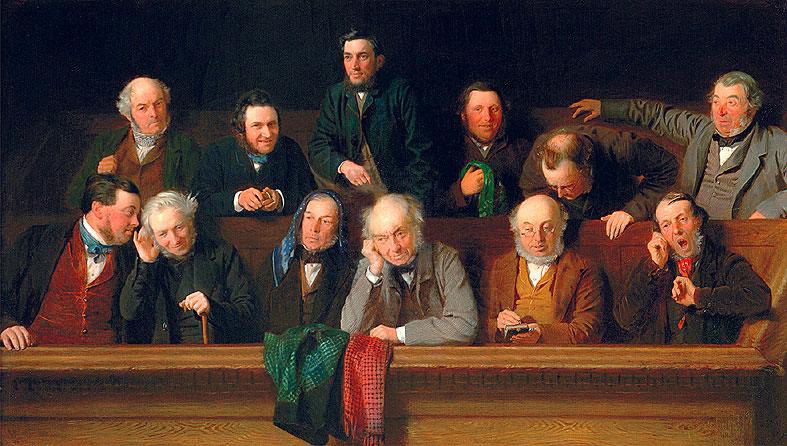
Image painted by John Morgan, uploaded to Wikipedia (en) by Swampyank (The Jury by John Morgan.jpg in Wikipedia (English)) [Public domain], via Wikimedia Commons.


[1]Andrew Guthrie Ferguson, Why Jury Duty Matters: A Citizen’s Guide to Constitutional Action139 (2013).
[2]Id.
[3]Id. at 157.
[4]Id. at 140. 

Tuesday, September 17, 2013

A Refreshing Reminder of Why Jury Duty Matters: A Review of Andrew Guthrie Ferguson's Book on Jury Duty


Andrew Guthrie Ferguson, Why Jury Duty Matters: A Citizen’s Guide to Constitutional Action

Google “jury duty” and you will quickly find websites dedicated to teaching you ways to avoid it.  Many websites compare jury duty to getting a cavity filled at the dentist, having to wait in the never-ending line at the Department of Motor Vehicles, or even wrestling an alligator.  In Why Jury Duty Matters, author Andrew Guthrie Ferguson provides an inspiring and educational analysis of the importance of serving as a juror in the United States court system, ultimately reminding us of our civic duty in the context of our constitutional history.


Ferguson, a law professor at the David A. Clarke School of Law at the University of the District of Columbia, begins his book with a story from his former career as a public defender.  He uses this story – one of his own clients waiting anxiously on a courtroom bench for the decision of twelve of his peers – to personalize the concepts he discusses and to provide a face to a process that may seem unfamiliar to many Americans.

Throughout his book, Ferguson reminds his readers why jury duty is so important to our understanding of American citizenship.  In the first chapter, “An Invitation to Participation,” Ferguson identifies an important question that any American being called to jury duty would be compelled to ask: “Why would you be asked to participate in something you have never been taught to do?”[1]  Ferguson recognizes that most people are not judges or lawyers, and most people have little expertise when it comes to constitutional concepts.  While Ferguson dedicates his book to answering this question, he first points to the Preamble to the United States Constitution: “We the People of the United States...do ordain and establish this Constitution for the United States of America.”[2]

While Ferguson turns specifically to the language of the U.S. Constitution to demonstrate the importance of civic participation, Ferguson makes a quick transition to address, in more practical terms, why jury duty is something that should matter to each and every American.  Ferguson refers to American citizens as “the source of constitutional power” and he points out that jury duty is one of the many ways American citizens participate in government.  Ferguson praises the drafters of the Constitution for establishing jury participation and explains that requiring citizens to participate in the judiciary is the best way to guard against overreach by a central government.  Ferguson believes that jury duty allows the people to have a presence in the judiciary and provides them with important skills required for a thriving self-government.[3]  Ferguson writes:

Jury duty elevates regular people to the task of contributing to the government.  After all, we wouldn’t want professional pundits or experts as the only people who could vote in political elections. ‘We the People’ need to be able to maintain the skills necessary to be active citizens.[4]

Instead of experts, a group of twelve regular people are given the power to decide the fates of their fellow Americans on trial.  Ferguson notes that each of these non-experts hears the same facts and the same arguments; it is on this equal footing that they then must make their decisions.

Throughout his book, Ferguson emphasizes the notion that jury duty is a responsibility that unites American citizens.  Serving as a juror allows a person to meet eleven fellow jurors that he might otherwise be unlikely to meet.  In addition, jury duty provides the opportunity for people to be introduced to a variety of new ideas and experiences.  Ferguson explains that this collection of diverse perspectives allows jurors to learn about topics that they may never have encountered in their lifetimes, while at the same time, promoting equality and fairness at trial.

The chapter entitled, “Selecting Fairness” includes practical aspects of what a juror might expect when arriving to the courthouse.  The chapter begins with a lesson on “voir dire” – the process in which fair and impartial jurors are selected – and progresses into a discussion on fairness.  While Ferguson admits to having rejected people for wearing obnoxious ties during voir dire, he explains that this process is not simply one of rejection, but rather, “is a function of trying to find people who feel right to the parties.”[5] 

Under the constitution, a system was established to ensure fairness during trial proceedings.  A fair voir dire selection is only one part of the system.  During a trial, jurors are provided with rules that are created to promote fairness.  Lawyers are also obligated to follow particular constitutional rules during trial.  Ferguson reminds his readers that while the constitution established a particular judicial process for fairness for those on trial, American citizens, serving as jurors, are similarly held responsible for upholding fairness in the courtroom.

Why Jury Duty Matterspoints out that in addition to providing an opportunity to be involved in American government, jury duty offers other important benefits to the American people.  For example, jury duty provides most Americans with an insider’s view of legal proceedings that most would never see.  Jury duty allows a close-up look at America’s judicial system for those who are not professionally involved in the legal world, and, according to Ferguson’s research, between seventy-five and ninety percent of Americans expressed that they had a positive experience with being involved in jury duty.

In his conclusion, Ferguson brings the reader back to his client awaiting his fate on the uncomfortable courtroom bench.  After being notified that the jury has reached a verdict, Ferguson’s client nervously walks back to the courtroom: placing his faith in the Constitution and in the twelve men and women who will now decide his fate.  Throughout his book, Ferguson educates his readers on the more unfamiliar and abstract historical context of jury duty, while at the same time incorporating a depiction of jury duty that many Americans may find easier to identify with: telling a story of a real-life American involved in the U.S. justice system.

Why Jury Duty Matters is a useful tool for all American citizens who will someday fulfill their civic duty by serving as a juror. While Ferguson admits that he recognizes that this “invitation” is not one that can be respectfully declined, he still encourages Americans not to cringe when pulling the jury service summons out of the mailbox.  Instead, Ferguson asks his readers to view the invitation as an opportunity for reflection, education, and fulfillment, rather than one of inconvenience.  Whether for an attorney or a judge trying to convey the significance of jury duty to the public, or simply an individual pulling a jury summons out of the mailbox, Ferguson’s book provides an insightful explanation as to why jury duty really matters. 

Why Jury Duty Mattersis a must read for every American citizen.


Meghan K. Zingales
Senior Editor, Criminal Law Practitioner


Image from Amazon.


[1] Andrew Guthrie Ferguson, Why Jury Duty Matters: A Citizen’s Guide to Constitutional Action 12 (2013).
[2] Id. at 12.
[3] Id. at 15.
[4] Id. at 22.
[5] Id. at 31.