Showing posts with label Zimmerman. Show all posts

Friday, September 20, 2013

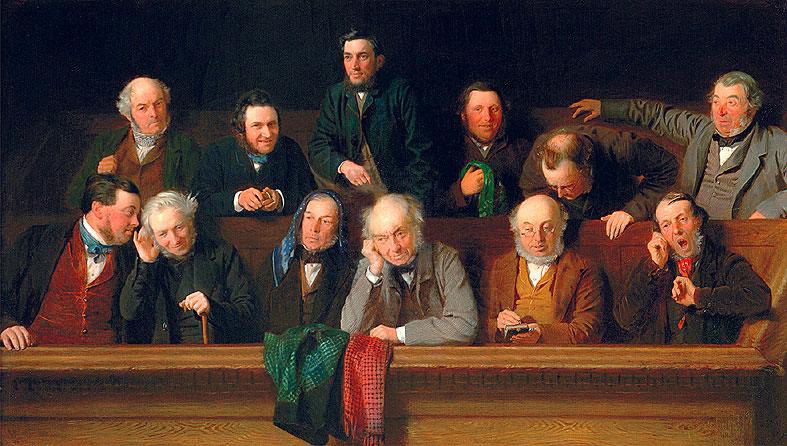
Juries: The Community Conscience in America


There it is.  “Breaking News: Verdict reached!” scrolls along the bottom portion of your television screen or appears as a notification on your newest smart phone.  We have all seen it.  We have all waited in nervous anticipation for it.  We flick to the nearest news channel, turn up the volume, and crowd around the screen as the criminal trial enters the final stretch.  Those final words are then composedly uttered, “We the jury find the defendant…”


Some rejoice, some scream expletives at the screen, and others reflect.  Some doubt the American legal system and yet others feel comforted by the protection it offered for their interests.  Either way, it served its intended truth-finding function – at least for the moment – and offered a just outcome.  Andrew Guthrie Ferguson, professor of law and former public defender, calls it “judging accountability.”[1]  Jurors have the unique opportunity – and obligation – to balance law and equity, employing the collective values of the community to determine alleged wrongdoing and making those wrongdoers endure the consequences of disturbing order.

In his book, Why Jury Duty Matters: A Citizen’s Guide to Constitutional Action, Ferguson highlights the challenging role jurors assume as they sit in the “seat of judgment.”[2]  In a representative capacity, jurors are the community conscience.  Ferguson shares how he personally observed jurors with tears and flushed faces at the end of criminal trials, which illustrated the inherently difficult nature of having to return a verdict.  A legal departure that all practitioners should be aware of, juries generally evaluate wrongdoing in light of their own personal attitudes.  Ferguson refers to this as “jury lawlessness,”[3]where juries appeal more to the characteristics of an individual at trial than the direct evidence they offer to the court.  This emotion cannot easily be suppressed.

In the recent years, we had the opportunity to bear witness to the notorious cases involving Casey Anthony and George Zimmerman.  In the world of public opinion, both Anthony and Zimmerman were believed to be guilty before the trials even commenced.  A modern day mob lynching, the national community looked past the trial phase and wanted to proceed directly to sentencing.  Such is the world with tensions running high.  However, Ferguson reminds us of the “awesome”[4]power vested in the jury.  He reminds us that, though serving as a voice for the larger community, the jury is charged with the task of carefully sorting through evidence finding a more accurate outcome at the end of an orderly process.

So how should we, the national audience with little or no direct connection to the trial, act when an emotionally charged case is being tried?  More importantly, how should we react when a seemingly controversial verdict is announced?  Insightfully, Ferguson sheds light on the actual circumstances in which jurors function during a criminal trial.  First, their verdicts lead to irrevocable consequences, both for the criminal defendant and the prosecuting agency.  The jury has one opportunity to get it right, otherwise an innocent man may lose his liberty or subject their community to the return of a criminal.  Thus, practitioners have one opportunity to get to know their jury and connect with each one of them on a personal level.  Second, their actions are bound by legal principles specifically tailored to the case at bar.  Judges, as well as counsel, bury the jury in complex rules that are supposed to govern the fact-finding stage of trial.  The larger public has the benefit of watching the story unfold in a series of uncensored stories in the media.  We as a national audience are not generally aware of those impactful rules – we just sit on the bench.

Juries not only hold criminal defendants accountable – assuming they are convicted – but they also hold the government accountable.  Ferguson wants us to be aware of the constitutional check juries have on prosecutorial agencies within the government.  The founders of the United States Constitution assured the future of America that its citizens would never have to fear criminal penalty without the due process of law.  That due process commonly lies with the jury.  In fact, where criminal defendants choose to waive their right to a jury trial and proceed with a bench trial, they do so because they know the law is on their side but not the consensus of public opinion. Ferguson addressed the discipline a jury must exercise in applying the appropriate burden of proof – beyond reasonable doubt – in examining the evidence.  We, the national audience, do not share that same responsibility.

At the end of his book, Ferguson left us with an important duty.  Instilling in us the values of the Constitution, he calls us to act as one deliberative body.  Whether we are called to carry out our civic duty and serve on a jury or not, we must live the Constitution and embody its principles.  Only then will we be able to show the jury in the next publicized case the respect they truly deserve.


Robert Nothdurft, Jr.
Senior Staffer, Criminal Law Practitioner


Image painted by John Morgan, uploaded to Wikipedia (en) by Swampyank (The Jury by John Morgan.jpg in Wikipedia (English)) [Public domain], via Wikimedia Commons.


[1]Andrew Guthrie Ferguson, Why Jury Duty Matters: A Citizen’s Guide to Constitutional Action139 (2013).
[2]Id.
[3]Id. at 157.
[4]Id. at 140. 

Tuesday, August 13, 2013

Why Not to Hate Jury Duty


Jury duty.  Universally dreaded, with sympathy for a friend or colleague who has been called, communicated with a knowing roll of the eyes, and a story about how to get out of it.  There is even a wikihow page entitled, "How to Get Out of Jury Duty."  Yet, jury duty is regarded by courts and civics teachers as one of the most important civic responsibilities a citizen can perform; it has been a crucial part of our democratic system for over 200 years.  The right to a jury trial is a fundamental right afforded by the Sixth Amendment of the United States Constitution, and the Due Process Clause of the Fourteenth Amendment.  A defendant charged with anything more than a petty crime, typically a crime with a penalty of more than six months of incarceration, has a right to trial by jury, made up of between six and twelve of his or her "peers."[1]  Jurors are reflective of the community at large; there is no education requirement, though jurors must be citizens, over the age of eighteen, and fluent in English, with few other restrictions.      

Jurors are charged with deciding whether a defendant committed the crime of which he or she is accused, or in a civil trial, whether the defendant injured the plaintiff or otherwise failed to perform a legal duty, and if so, what the penalty should be.  Sometimes jurors are called upon to determine the life or death of a defendant.[2] 

Jurors must be fair and impartial.  In thoughtful deliberations, they can consider only the evidence presented to them within the confines of the jury instructions they have been given, and then apply the evidence to the law, relying on reason and common sense.  Jurors must leave questions of the law for the judge to determine.  There is no googling, tweeting, independently visiting the crime scene, or reading media coverage about the case.  Jurors are not even supposed to discuss the case with other jurors as the trial goes on.  This is to discourage the jurors from forming an opinion before all of the evidence has been presented to them.         

The role of the jury is a complicated one, marred by cases decided by prejudice, and doubts about whether jurors are capable of adequately understanding evidence or making the required factual determinations.  Individual jurors may be unpredictable, biased, or unwilling to deliberate thoughtfully.  Nonetheless, in their purest form, the jury trial provisions in federal and state constitutions reflect a fundamental decision about the limits of official power and reluctance to entrust power over the life, liberty, and property of a defendant to one judge, or a group of judges.  In an ideal world, a jury trial acts as a defense against arbitrary law enforcement.[3]

The trial of George Zimmerman brought, among other things, conversation and questions about the role and responsibilities of juries in criminal trials.  In Zimmerman's case, there were only six jurors, the minimum number of jurors constitutionally allowed in a criminal case.[4]  The jury was made up of all females, five Caucasians,and one possibly Hispanic, according to media accounts.  Perhaps it was not the most widely representative cross section of Americans, but a jury is not required to be of any particular make up, only that its members were selected pursuant to nondiscriminatory criteria.[5]

In such a widely publicized and divisive case finding jurors that could be fair and impartial was bound to be a challenge.  It is no less important, however, in any criminal case.  Attorneys on both sides have different ways of trying to glean who may be more inclined to be sympathetic to their side.  They might ask what the potential juror does for a living, if they have ever been the victim of a crime, or convicted of a crime, for example.  Potential jurors may be stricken for cause when there is a legal reason the individual may not serve, such as being a relative of the defendant, counsel, or a witness.  After that, each side has an opportunity to make preemptory challenges, effectively striking a potential juror without having to offer an explanation of why.  This does not present either side with an opportunity to eliminate any potential jurors it thinks will be unsympathetic.  For example, racial discrimination, or eliminating a juror on the basis of race because one side or the other believes a person of that race would be unable to fairly decide the case, is a violation of not only the right of a defendant to have a juror of his peers, but also of the juror.  Furthermore, the harm inflicted by such action not only affects the parties involved, but also impacts the confidence the community has in the fairness of the system.[6]

A potential juror’s ability to put aside personal feelings, experiences, biases and opinions, and to instead weigh the evidence and facts presented in a particular case is at the core of the inquiry made by the judge and attorneys during voir dire.  Zimmerman Juror B29 spoke out after the verdict and explained that they, the jurors, had to put aside their personal feelings and look at the evidence.  Though she explained the grief she experienced in coming to the non-guilty verdict, Juror B29 said there was not enough proof to convict.  B29's statement made some viewers angry, and devastated the mother of Trayvon Martin, who clearly hoped for a different outcome.  Zimmerman's attorney called her a "model juror."  No matter which side you take, what B29 described doing is perhaps the most difficult and important part of a juror’s duties.   
     
This past week, as an intern in a prosecutor's office, I sat through my first trial of the summer.  The jury was unable to reach a verdict.  After the trial, I was allowed to return to the jury room with defense counsel and the Assistant United States Attorney where the jurors agreed to speak about the case, and their deliberation.  I was struck by how seriously the jurors took their role; the questions and concerns they had, made clear how closely they listened over the two days of trial.  They knew the names of all the witnesses, and street addresses of the relevant locations.  They wrestled with the same issues we anticipated might be the sticking points, and ultimately they could not overcome a few remaining questions.  They mostly seemed to think the defendant had done the crime, but just needed something more than what the government had to offer to find guilt beyond a reasonable doubt.

For all the popular groaning about the pains of jury duty, the majority of Americans still think that a jury trial is the fairest way to determine guilt or innocence in a criminal trial.  Jury duty can be inconvenient, boring to some, and even feel like a responsibility you would not want to bear, but the right to a jury trial is a fundamental part of our criminal justice system and requires the serious and thoughtful participation of us all.


[1]See Strauder v. West Virginia, 100 U.S. 303, 308 (1880).
[2]See Ring v. Arizona, 536 U.S. 584 (2002).
[3]See Duncan v. Louisiana, 391 U.S. 145 (1968).
[4]Ballew v. Georgia, 435 U.S. 223 (1978).
[5]Batson v. Kentucky, 476 U.S. 79 (1986).
[6]Id. at 87.


Sarah Tynan
Managing Editor, Criminal Law Brief


Image from Boston Public Library, Flickr

Wednesday, July 17, 2013

UDC School of Law Professor Andrew Ferguson Weighs in on the Role of Juries and Their Verdicts


On Saturday, July 13, 2013, the jury in the State of Florida v. George Zimmermanreturned a verdict of not guilty for second-degree murder and manslaughter for the fatal shooting of Trayvon Martin.  After the jury returned the verdict, an expected flurry of news and social media erupted, some in support of the verdict and many others criticizing it.  Given the contentious issues surrounding the case, a vast amount of media attention has honed into the jury and what occurred during the jury's deliberation.  One can hope that the jury deliberation of the Zimmerman trial was similar to the one that took place in the famous stage play and movie, Twelve Angry Men, where the jurors carefully examined all the evidence in their quest for the truth and banished personal prejudices from their deliberation.  On the other hand, many fear that racial biases may have affected the deliberation of the Zimmerman jury that was made up of five Caucasian women and one Hispanic woman.  Whether the deliberation was similar to that of Twelve Angry Men or corrupted by racial bias, many questions remain.

In his article, "The Zimmerman Trial and the Meaning of Verdicts," Professor Andrew Ferguson of the University of the District of Columbia, discusses the Zimmerman jury, the (at the time undelivered) verdict, as well as juries and their verdicts in general.  


Professor Ferguson currently teaches criminal law, evidence and criminal procedure. Prior to his tenure at UDC, Professor Ferguson worked at the Public Defender Service for the District of Columbia.  His most recent book, which reflects what the American public is perhaps most interested in following the return of the Zimmerman verdict, is titled Why Jury Duty Matters: A Citizen's Guide to Constitutional Action, is a book about jury duty for jurors and those who may serve on juries, the first of its kind. 

In September, 2013 the Criminal Law Brief Blog will be posting reviews by Meghan Zingales and Robby Nothdurft on Professor Ferguson's book:  Why Jury Duty Matters: A Citizen's Guide to Constitutional Action. You can now follow the blog by email so you do not miss the reviews and you can stay up to date with weekly posts.  To read more about Professor Ferguson and a list of his publications click here


Raleigh Mark
Blog Editor, Criminal Law Brief


Left Photo: By VOA [Public domain], via Wikimedia Commons.

Right Photo: By ann harkness (Flickr: med-9529.jpg) [CC-BY-2.0 (http://creativecommons.org/licenses/by/2.0)], via Wikimedia Commons.